09 January 2011

Comfort Food Sunday


Only the most dedicated of local food patrons braved the weather yesterday to stop by the chilly tented Athens Own booth in search of creamy cheddar cheese, hot coffee, a bowl of piping thick oatmeal, or a pound of ground beef certain to be brewed into chili later that afternoon. Snow was swirling down in flittering drifts from the clouds, and being windswept in horizontal sheets across the barren, ice caked parking lot of the Market on State where four lonely vendors withstood the cold to deliver their precious goods to local Athens customers. Needless to say, in my knee high boots and intricately woven pink and purple Thai scarf, I was one of those frost-bitten customers.

As a point of appreciation, and also my desire to be an active member of the vibrant Athens food community, I am slowly but surely working my way to a first name basis with many of the market’s locally famous producers. While some people are excited to meet celebrities of musical or cinematic fame, I am excited to meet the farmers I see at the Athens Farmer’s Market every week, year in and year out. For a long time, it would never have crossed my mind to introduce myself to one of the weathered, smiling faces with which I would have weekly business interactions. In fact, I wouldn’t have introduced myself to anyone and no one introduced themselves to me. Confidence can do wonders for a personality. It is rare lately that someone would not smile or say hello to me, as I try to do the same. I notice more often than not that people look at me, smile, and give me kind expressions. Yesterday, this quality helped me meet Constantine.

When I found myself at the entrance to the igloo like structure Athens Own had constructed for their array of products, I also found myself peering into the back of the tent for a package of beef stew meat. It’s been “that time of year,” for quite awhile now, and I still haven’t made one of my favorite winter staples: Beef Stew. Yesterday was the perfect day to dream up a recipe, and gather the ingredients with bone-chilled knuckles clenched around delicate mushrooms, dirty potatoes and pungent onions. I crafted in my mind a loose idea for a locally rich stew, made in the style of Beef Bourguignon, but lighter and steeped in the root and soil flavors of Appalachia’s deep winter. This is where Constantine entered my life, because alas, there was no stew meat.

Constantine owns Athens Own, where I buy infamous Cheddar Cheese, and addictively good sweet beef bologna. With a graying mustache tickling the edges of his lips, and matching beard that followed the flow of his words, he introduced himself to me and then explained that stew meat isn’t his most popular cut, but that it was available at a local grocery store. Through round, metal rimmed sunglasses and the cloak of a hooded sweatshirt he took the time to tell me about the different producers he uses, as well as the difference in the grade of beef. He suggested I try to the more expensive, 14 week dry aged stew meat, even though many people say the flavor doesn’t matter for stew. Constantine had my number, because I, for one, certainly know that the flavor matters and that the quality of the beef will make the difference between any old stew and an epic stew. He was delightful and I look forward to seeing him again soon and continuing to become familiar with and embed myself in the Athens Food community.

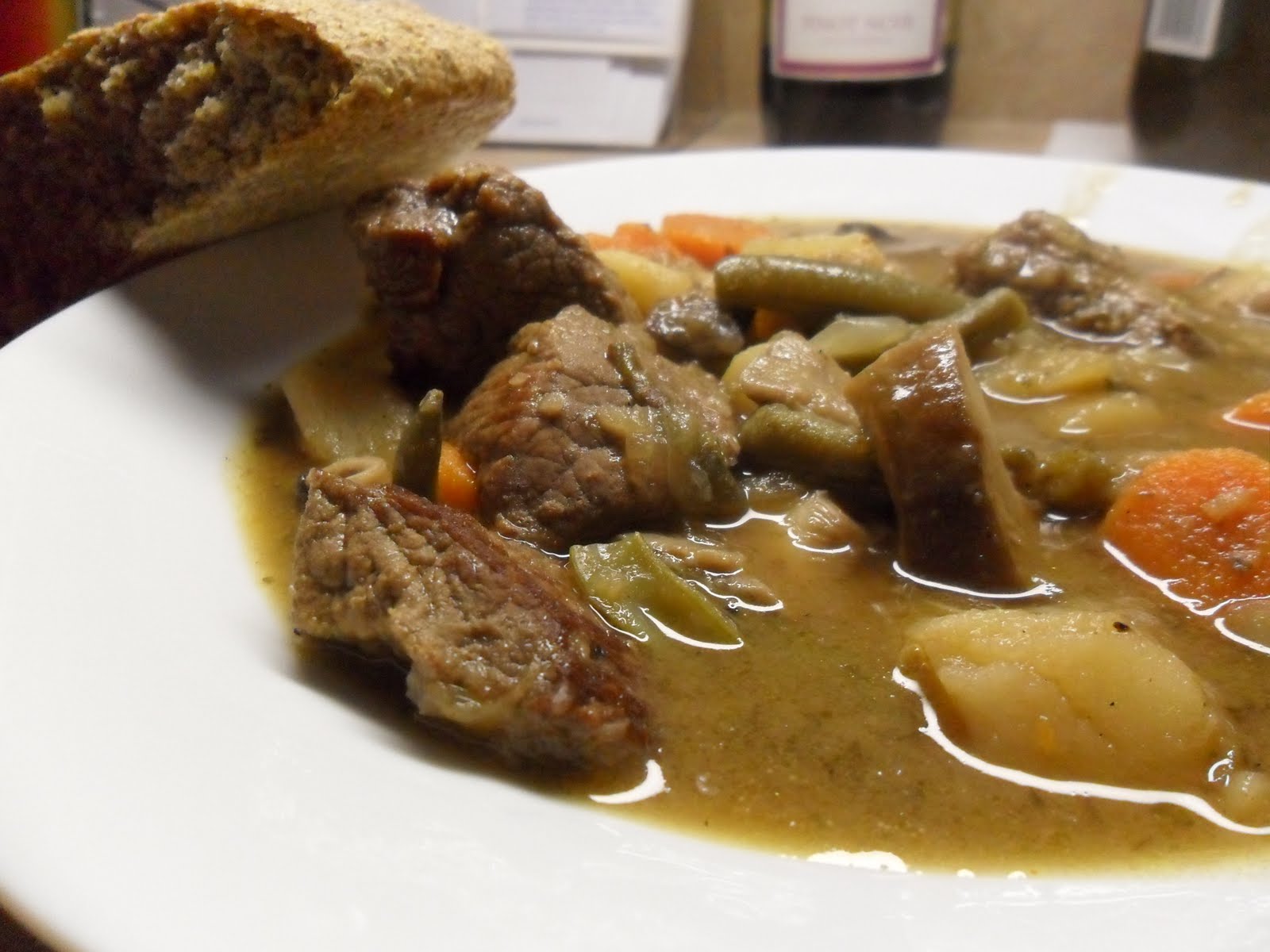
So for Constantine, who told me to let him know how the stew came out, here is the recipe for my Midwinter Beef Stew, served up hot with homemade buckwheat-corn bread and chased with a slice of homemade apple pie.

Queen Honeybea’s
Midwinter Beef Stew
Serves 6
2 TBS. extra virgin olive oil
1 lb. locally raised, dry aged beef for stew (rinsed and patted dry)
Salt and black pepper
2 cups chopped local mushrooms
1 cup chopped local yellow onion
2 cloves chopped local garlic
2 TBS. dry red wine
4 cups organic, low-sodium beef stock
2 TBS. pale ale honey mustard (or any pungent mustard you like)
1 TBS. red wine vinegar
6 small local potatoes, peeled and chunked
2 organic carrots, peeled and sliced into ¼ inch chunks
1 cup local green beans, snapped into 1 inch pieces (Mine were frozen from August)
1 tsp. salt
½ tsp. black pepper
2 TBS. dried parsley
A pinch of ground thyme
A pinch of ground rosemary
A pinch of Hungarian paprika

1. In a coated Dutch Oven, heat the olive oil over medium heat. Sprinkle the rinsed, and dried pieces sparingly with salt and pepper. Sear each piece of meat on each side until lightly browned, turning to ensure all surfaces are cooked. Remove the meat to a paper towel lined bowl.
2. Add to the Dutch Oven the mushrooms and onions, stirring almost constantly to keep them from sticking to the pan. Sautee, stirring for five minutes, or until the mushrooms and onions begin to sweat. Add the garlic, stirring, for 20 more seconds. Add the red wine, scraping the bottom of the pan to get all the goodness up into the stew. Cook for another minute or two, or until the wine is reduced.
3. Add the rest of the ingredients in order, along with the reserved pieces of beef. Stir to incorporate and slowly bring the mixture up to a boil. Reduce the heat to very low, and cover partially. The stew should be slowly simmering. Stir occasionally and taste to adjust the seasoning as needed. Simmer slowly, covered for at least one hour and uncovered for at least one hour. Ideally, simmering covered for 2 hours and uncovered for one will yield a nicely flavored stew with a thick but not too thick broth. Serve piping hot with crusty bread.


This stew was absolute perfection. Not to toot my own horn, as if I’d ever dream of that, but it truly was a simple masterpiece if I do say so myself. The beef was incredibly tender and had such a decadently soft texture. I can’t thank Constantine enough for his recommendation. I also have to give credit to Roger Graves at Yankee Street Farm in Vinton, Ohio for the beautiful, dirt coated potatoes I bought from him at the market, which turned into little pieces of pearl colored velvet in my stew. I was surprised that when I reached the bottom of the bowl there were just potatoes left, as I was saving the best for last. I hope you make this stew and enjoy the same sort of hearty romance I did, as I sipped its silken broth and nuzzled into the corner of my couch on a cold winter’s night. Remember, of course, to always buy local.


My apple pie chaser. Mama pie and baby pie. My half-and-half crust, fresh local apples, organic sugar, cinnamon, freshly grated nutmeg, a hint of lemon zest and lots of patience and love. Pies are an art for me, I adore making them.

06 January 2011

100 Miles or More: Part One


I was still just over an eighth of a ton, and my body was more than vocal about its unhappiness. Two hundred and fifty-seven collective pounds don’t want to pick blueberries from the branches of a bush dwelling twelve inches off the ground. It’s more than just the knees. While I had shed thirty pounds, and was seemingly holding that position steadily, picking blueberries required energy. Years and years of High School science class, and one of the few things I remember is that energy is required to move mass. My thighs cannot power me upwards, thrusting at the knee, without the required amount of energy. I also know that moving mass becomes more and more difficult when the mass is greater and greater. When I think of my body this way I imagine that level of Dante’s inferno where the man is pushing a great rock up the hill, only to have it roll down again. And like the consistency of daily life, the rock must always be moved again. It cannot be sedentary at the bottom of the hill, it must always be moving. I was twenty-three years old. Quitting my life was not an option that was presented to me. I would be moving the rock again.

I wrote these words recently about the summer of 2009, now eighteen months ago. I have been asked so many times about my journey of reinvention that I decided to start writing about it regularly, in hopes of compiling something coherent, logical, and poetic eventually. The complexity that weaves this process is enormous and entangled, and the thought of unwinding the fibers one by one in order to tell a complete, tightly woven story is daunting to say the least. While it will be impossible for me to recall every moment, every event, every passing word and fleeting action that led me to this contentment where I now dwell, I have promised to share at least a portion of it with you, in order to help my friends and family understand how someone goes from 287 pounds to 189 pounds in a healthy, transformative way.

I could spend several paragraphs now detailing the changes I made to my eating habits, and explaining the different kinds of exercises I have tried, done and re-done to lose this amount of weight, but that would be like giving someone a basket of ingredients and asking them to create a specific dish without also providing them with a recipe. There is a story behind every great success and every great failure. As anyone who reads this blog regularly knows, I love words, and like my literary heroine Baroness Karen Von Blixen, I love stories and understand their importance. For anyone who is reading this thinking they’d like to make positive changes to their lives, I encourage you to think about why you want to make these changes, and to understand that you have a story of your own, so make it personal to you and envelop these changes within your own pages.

I have to begin this story honestly. I will not lie to you and say that it was divine intervention, or cosmic karma, or that something specifically struck and inspired me one day in the mid-winter of 2009. I remember the day well, and I remember the first decision I made to which I actually adhered, but I have no recollection of why I made that decision, or why it realistically worked for me that time. I know that I had tried and tried so many times before. I had tried since I was eleven years old, when I began to hit puberty and realized that my body wasn’t going to develop into an hourglass, or even a tender, ripe pear. I realized that my body was already large, it was fat, and that I wasn’t going to embody the hyper-sexualized image into which all of my friends’ bodies would be maturing. Until that February day, two years ago, I hadn’t been able to commit to making any changes concerning my body. It was therefore surprising to me when I decided on February 24, 2009 to give up dessert for Lent, and when Easter Sunday morning dawned, I hadn’t broken my Lenten promise. Not only that, I had lost seven pounds.

That’s where it all began. I specifically remember eating two prune paczki on Shrove Tuesday, then bagging the other four from the box and throwing them into the freezer. I don’t know what rennet caused that decision to separate from the rest of the so-called decisions I’d made in the past. It was different, however. This decision led to another decision soon after. Instead of spending my long, unemployed days sitting around doing nothing, I’d try to start exercising a little. As I sit here in the shortest skirt I’ve ever worn in my life, legs crossed with sheer black leggings stretched tightly across my thighs, I can’t help but be taken aback by the evolution of my exercise routine. I remember sitting in a baggy pair of navy blue sweatpants, an over-sized neon orange Cleveland Browns hoodie, and pair of worn, old pink and gray Vans sneakers on my living room floor, thinking that walking for fifteen minutes was exhausting.

My mother walks in circles around our house. It’s good for her knees, and more comfortable for her all around. My Mom has had a lot of success. When I was living in Athens my house was set up in such a way that I could also walk in circles around it. I tried to walk for 15 minutes every day. I had no motivation to do it, but for the first time in my life I forced myself to do it. I wish I could explain why or how I did. I have theories, certainly.

At that point, there were so many things about my life that were slowly eroding. The previous June I’d graduated from Ohio University with no job prospects. That September the economic recession hit. By the time February rolled around, I’d spent eight-months without work. It wasn’t just that I was without work, but rather without ever working. I hadn’t had an opportunity to take that important step into adulthood and I was feeling worse about myself every single day. It was far more than just not having a job, and not being able to support myself. It was constantly thinking that what I’d studied in college, which I thought to be so important, was thought to be useless by so many people. After hearing it so many times I began to believe it and I began to resent the university, resent my degree and resent the idealistic values I’d set. My confidence was plummeting to a place from which I never thought I’d be able to resurrect it.

Simultaneously this, along with some other outside factors, was causing strain on and within my long-term relationship. While delving into the most intimate and personal details of what happened isn’t the point of this blog, it is a part of this story. I believe anyone can relate to how changing relationships affect our lives in one way or another. When you feel something that you once held securely begin to slip out of your fingers, you grapple for control. There came a point in my relationship, much later than where this story is beginning, where I was losing it. My deep-seeded mission of crafting and changing my body gave me a sense of control over at least one portion of my life. When the relationship finally ended, and my focus was able to shift solely onto my own needs is when I really dove head first into this journey and started making major changes.

That brings me to the last thing I want you to understand about making changes to your life. While you may start with one goal, one plan, or one course of action, it’s highly likely that it’s going to be altered, shifted or changed. On that February day when I threw the paczki into the freezer, my goal was to not eat another one (or any of its decadent kin) until Easter Sunday; it wasn’t to lose a hundred pounds. My goals evolved, my routine evolved, and the path by which I traveled evolved. For me, it was essential to be open to changes. In the end, it benefited me greatly. If I was still eating the way I used to eat, only omitting dessert, and walking for 15 minutes a day, I would still be unhealthy and probably unhappy. Life is about change, growth and development, so embrace it.

Because this is a story, I’m going to break it down into chapters. It wouldn’t serve well for me to simplify it too much, to try to squeeze it into one blog post, without giving it proper credit. This is the beginning: one small decision, leading to another small decision. That’s where I started.

23 December 2010

Mary Christmas

I imagine on Christmas morning, there are many people in this world who wake up to a day that is just like any other day of their lives. After listening to the song “Wintersong,” by Sarah McLachlan on repeat the past few days, I could not help but ponder and dwell on people who find the often forced gladness of our cultural holidays to be nothing more than sad, or rather exceptionally more sad than the other days of their lives. The circumstances of my own life have been such that Christmas has, until last year, been an unquestionably happy occasion. The warmth and tidings I received from spending the eve of and Christmas day itself with my family, my most loved and cherished human connections, was overwhelming. Now, finding my circumstances changed on so many levels, I am facing Christmas from a new direction. I cannot help but think of my most beloved character in the nativity story, and the direction from which she faced that very first Christmas.

It is easy for us to see a nativity scene, perhaps figures cut out of one-dimensional fiber board painted to look like us, pale and rosy, and never think twice about the knowing and contented smile given to Mary’s expression. It is assumptive of our society to believe that women are always filled with happiness upon the birth of their children. We do not want to believe otherwise, because that would mean that women may serve another purpose on this Earth apart from bearing the next generation of the species. I felt especially compelled to write this blog after my week at work was filled with conversation about children and family, and more specifically, after talking to my co-worker about the post-partum depression she experienced. Note that a woman who feels depressed or saddened after giving birth and facing the reality of now having to care for every need of a tiny, undeveloped human being has to be referred to as a medical condition, and not simply a normal, or healthy occurrence.

Can you imagine what Mary’s first Christmas was like? Think of your most loved family members. Think of the only people you’ve ever known to be loyally, devotedly yours. Think of the people you’ve always known, the townspeople and villagers that make up the passersby, the comings and goings of your day. Think of the woman at the drugstore who always asks about your son. Think of the man who delivers your mail and waves at you from the loading dock of the sleepy morning Post Office as you drive past. Think of the familiarities, the things from which you derive unconscious comfort each day. Now think of venturing far from that place, those people, and that comfort. You are traveling to a place you’ve never been with someone you barely know, who has been entrusted with your care. You are nine months pregnant, and those months have been filled with ridicule, skepticism and flat out confrontational harassment. You’re a teenager. This is your first child, and therefore your first everything. Is it impossible to imagine that after her baby was born, that perhaps instead of the glistening ray of a divine star shining through the roof of a barn, illuminating a post-card portrait of a new family, that instead Mary was just a bit frightened, unsure, and worst of all, perhaps lonely? It isn’t hard for me to imagine, and these thoughts make me love and cherish her so much more. I want these thoughts to help comfort others who feel those kinds of emotions this coming holiday.

This will be my second Christmas that is somewhat different, not only from the last, but also from the 22 I’ve celebrated before. I can’t help but feel my heart connecting to Mary and the bewilderment of a screaming child, in a lonely, unfamiliar and isolated place. When she found the familiarity of a swollen belly and a tiny, gentle kicking from the inside out to be gone and before her lay a human infant she’d never experienced as her own before, I think that’s something we can all relate to in one way or another. But the joy of this story is that the comfort returns, that we are resilient creatures, that love is our most powerful connector. As I move on from Sarah McLachlan’s “Wintersong,” to Patty Griffin’s “Mary,” I listen to words written about a woman who bears it all. A story of a mother who loved her child more than she loved herself, and while her worth is not measured in that selfless love, it shines on her personality, her character and her sense of devotion to something larger than, greater than herself. The things in this world that we find are greater than ourselves are the things I find myself taking comfort in on these somewhat lonely days leading up to Christmas. Compassion and love remind me daily of why we’re celebrating on Saturday. The joy that lights my face when I think on the new friends I’ve made, the loyal kinship I’ve found with a handful of beautiful people I’d not known before reminds me that celebrating goes far beyond a tinsel trimmed tree and a man in a red suit. Seeing the face of the mother that loves me, as Mary loved her own child, reminds me that some of what is familiar to me will always be so, that I will not lose everything, that there are things in which I can still trust.

I will spend Christmas Eve using my hands to knead pasta dough, and my fingers to roll out tiny, delicate cavetelli on a floured board, just the way my Grandmother did. My mother is going to teach me how to make them for the very first time. I spent the week making Italian Panettone, reminding me of the warm, crusty slices my Mom would take from the toaster and slather with butter for me at Christmas time when I was a child. I made torrone from scratch, an Italian nougat candy as old as Ancient Rome, which made my mind recall the Christmas dinner’s we’d spend at my Aunt and Uncle’s house. We’d sit around a table in a dimly lit, blue wall-papered dining room, surrounded by breakable pieces of Fitz and Floyd and Spode dinnerware, and an antique silver service. Around this table we’d laugh, eat far too much, and end our meal unwrapping tiny portrait painted boxes of lemon, orange and vanilla torrone. The familiar has not left me. Comfort and joy thrive within my memories, my heritage and the newly sewn patches to the quilt that blankets my heart. Buon Natale. Merry Christmas from Queen Honeybea.


Panetone.


Gooey Torrone.


Perhaps my favorite Christmas song.

19 December 2010

Made From Scratch: Vegetable Lasagna

When someone tells you something is made from scratch, does that typically make it more appealing to eat? It does for me, and this week I put together a vegetable lasagna for a potluck I’ll be attending this evening. I know there will be several vegetarian guests, as well as many people who enjoy, appreciate and work for local food access at said potluck. It has also barely climbed above single digits here in balmy South East Ohio over the past several days, so I also knew I wanted to make something warm, hearty and soulfully cozy. For me, this has always been a bill fit by lasagna. For me now, that meant creating a lasagna that would provide some nutrients along with its cheesy richness, as well as incorporating as many locally produced and homemade ingredients as possible. Below is what I came up with. When pulled from the oven after baking until bubbly, this lasagna looked and smelled like perfection.


Queen Honeybea’s
Vegetable Lasagna


The Parts:

Ricotta Cheese
Vegetable Filling
Tomato Sauce
Lasagna Noodles


Part One: Ricotta Cheese

Homemade Snowville Creamery Ricotta Cheese
(Adapted from the Snowville Creamery website)

One gallon of Snowville Creamery Whole Milk (or other locally produced milk)
6 TBS. distilled white vinegar
1 TBS. salt
Cheesecloth
Candy Thermometer

1. In a large sauce pot using the candy thermometer, heat the milk slowly to 180 degrees F. As soon as that temperature is reached, stir in the vinegar and salt. Assure that the milk either again reaches, or remains at 180 degrees F, then remove it from the heat. Cover and let stand for 15 minutes.

2. In the meantime, line a large colander with 2 layers of cheesecloth. Wet the cheesecloth so that it conforms to the colander, and make sure the edges of the cloth extend above the top of the colander and drape over the edge.
3. After 15 minutes, scoop the separated curds out of the milk mixture and into the cheesecloth lined colander. Once you’ve removed most of the large pieces, drain the whey through the cheesecloth to ensure you get all of the curds. Then, pull the edges of the cheesecloth together and hang the bundle of curds over a bowl or over the sink for 15 minutes. This will produce a soft, silky ricotta.

4. After 15 minutes of hanging, remove the collected cheese to a bowl. This should produce about 2 cups of ricotta cheese.


Part Two: Vegetable Filling


Sautee of Red Onion, Mushroom and Spinach

1 TBS. extra virgin olive oil
One large locally grown red onion, diced
16 oz. of locally grown mushrooms (I actually used shitake, they were delicious), diced
16 oz. of locally grown spinach, roughly chopped
½ tsp. garlic salt
Black pepper

1. In a large skillet, heat the olive oil over medium high heat.
2. Add the diced red onion and diced mushroom pieces, and cook stirring frequently until the onions begin to turn translucent and sweat and the mushroom pieces appear moist and plumped, about 6 or 7 minutes.
3. Add the chopped spinach, garlic salt and pepper (to taste) and cook again stirring frequently for 4 or 5 more minutes, until the spinach is wilted and the vegetables appear to be cooked. Set aside to cool.


Part Three: Tomato Sauce

Quick Sauce for Lasagna or Baked Ziti

1 TBS. extra virgin olive oil
One clove of garlic, minced
15 oz. can of organic fire roasted crushed tomatoes
15 oz. can of organic tomato sauce
8 oz. water
½ cup red wine
1 tsp. dried oregano
2 tsp. dried basil
½ tsp. salt
Black pepper

1. In a medium size sauce pan, combine the oil and garlic while you open the cans of tomato sauce. Pour in the crushed tomatoes, tomato sauce, water, wine, oregano, basil, salt and black pepper (to taste), stir to combine and bring to a boil.
2. Reduce the heat to a simmer, and simmer uncovered for about one hour, or until the mixture is reduced and thickened slightly and tastes correct. Set aside to cool.


Part Four: Lasagna Noodles

Queen Honeybea’s
Almost Whole Wheat Pasta (For One Pound)


1 cup whole-wheat flour
½ cup organic, unbleached all-purpose flour
½ cup semolina flour
½ tsp. salt
2 local, free range eggs
2 TBS. water
1 TBS. extra virgin olive oil
Pasta maker

1. In a large bowl, combine the flours, and salt. Make a well in the center.
2. Into the well, crack the eggs and add the water and olive oil. With a fork, whisk them together, slowly incorporating flour from the sides of the well. Gradually incorporate all the flour, switching to your hands when it becomes too much for the fork to handle. Knead this into a stiff dough, making sure it is incorporated and binding together. Wrap in plastic wrap and let rest for 15 minutes.
3. In the meantime, set up your pasta maker on a lightly floured pastry cloth. Cut of ¼ of the dough at a time, and press through the thickest setting on the pasta maker. Fold this piece of rolled dough in half, then press it again. Repeat this four times in order to further knead the dough and achieve the proper consistency.
4. Then, gradually press the dough to your desired consistency. On my pasta maker, for lasagna noodles, I use the second to thinnest setting. Repeat and continue until all of the dough is pressed into lasagna noodles.


Finally…

Queen Honeybea’s
Vegetable Lasagna


One pound of fresh lasagna noodles
3 cups homemade tomato sauce
2 cups cooked vegetable filling
2 cups fresh, homemade ricotta
1 cup shredded fresh local melting cheese (I used Laurel Valley Creamery’s Havarti), divided
1 local, free-range egg
½ tsp. salt
¼ tsp. black pepper
¼ tsp. freshly ground nutmeg
2 TBS. locally produced 2% milk
1 TBS. local, raw honey

1. Pre-heat the oven to 375 degrees. Cook the lasagna noodles in batches, lifting them out of the water when they’ve reached al dente, then draining and cooling them flat in a large colander so they don’t stick together. At full boil, they should take between 2 and 4 minutes to cook to al dente.
2. Grease a 9 x 13 inch casserole pan, or metal or glass pan. Ladle a 1/3 cup of tomato sauce onto the bottom of the greased pan. Then lay out one layer of lasagna noodles.
3. Make the ricotta filling by combining the ricotta cheese, 2/3 cup of the shredded melting cheese, the egg, salt, pepper, nutmeg, milk and honey. Mix until well combined and creamy.

4. Top the lasagna noodles in the pan with half of the ricotta filling. Then top the ricotta filling with half of the cooked vegetable filling. Top with 1 cup of tomato sauce and another layer of lasagna noodles.
5. Repeat with the rest of the ricotta, and vegetable filling and one more cup of sauce. Top again with lasagna noodles. On top of the very last layer of lasagna noodles, pour the remaining 2/3 cup of sauce. Cover tightly with foil and bake at 375 degrees for 30 minutes.
6. Remove the foil and top the lasagna with the remaining 1/3 cup of shredded melting cheese. Cover again with foil and return to the oven for 15 more minutes, until the lasagna is bubbling and the cheese is melted. Serve hot.


Makes one 9x13 inch lasagna. Remember to buy local.

14 December 2010

All I Want for Christmas


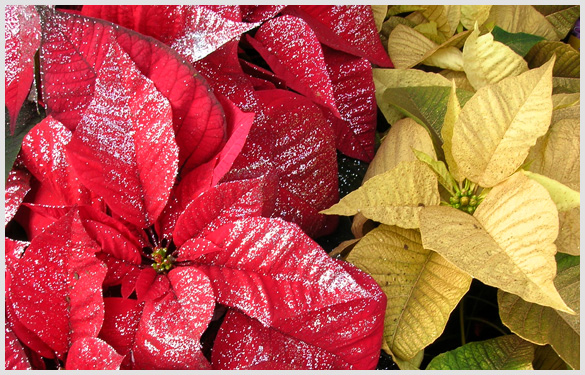
With the sun heating us up to a balmy fifty degrees, last Saturday could've practically been springtime in Athens County, Ohio. Practically, but not really, as I ducked out of the path of a chilly December wind and into the vast hangar like shopping mall known as The Market on State, echoing with childrens'voices and music. The first thing to catch my eye was a cluster of glitter dusted, gold flecked, red velveteen poinsettia leaves. This is no springtime sight, although mall shoppers may have been convinced otherwise by the mile long spread of tables loaded with fresh local greens, turnips, potatoes, apples and radishes that lay before them. Still no, because the leaves and small inconspicuous blooms of poinsettias come bursting from shiny, foil coated pots only for one occassion per year. Merry Christmas.

Donning leg hugging skinny jeans, a light coat adorned with a costume jewelry flower pin, and sequin bangled black flats, I was tempting Old Man Winter in more ways than one. With a silver-framed cloth basket in hand, I purchased and toted freshly picked spinach, a bag of dirt-scented fresh mushrooms, green and pink tomatoes and a dozen shiny, sweet red and yellow onions. The farmers in Athens County and in many other places that consider themselves part of a four-season America have taken January by coup d'etat and reclaimed fresh, green produce for all of their grateful consumers. They've mastered the art of seasonal growing, green houses and cool-season crops. For this, I am extremely grateful, because the contents of my trendsetting cloth bag are going to flirt, date, marry and consumate a vegetable lasagna of epic local proportions for a lovely Sunday potluck, celebrating the Winter Solstice.

After taking my leave from the part indoor, part outdoor market, with absolutely divine local Havarti from Laurel Valley Creamery and a sweet, robust Beef Bologna from Athens Own chilling in my cooler, I headed out to visit Athens, Ohio's long lost, red-headed step-child: Nelsonville. I say this because, if you utter the word "Nelsonville," to people from Athens County, you are greeted with a host of negative, skeptical and often classist reactions. However there is beauty to be found in curly red locks and an off-beat personality. Nelsonville is a little like Athens, and a little something all its own. It has to be taken and experienced for what it is, appreciated and loved for its quirks and offerings, and laughed at, or rather laughed with, when necessary.

My grand plan for this entire nippy yet warm, melting Saturday was to partake in some major local Chritmas shopping. I had no intentions of Christmas shopping at all this season. I had planned to make a donation to a local charity and have that serve as a Christmas gift to the short list of people who matter to me most. However, there are two people for whom I wanted to compile something extra special. One I have known for many years, and the other I barely know at all. Both have been wonderful, supportive friends to me this year (or rather a portion of this year), and I know both will enjoy a locally themed gift. I wanted to share a few of my favorite things with them, hoping that in turn would help them know and understand me better. Not forgetting, of course, that local Christmas shopping is the best Christmas gift we can give to our communities. I picked up a few non-perishable foodie things at the Farmer's Market (which I won't explain in detail because I know at least one of them reads this blog), and this is where Nelsonville came into perspective.

There is a little ceramics shop on Nelsonville's Public Square where I've been shopping for years, picking up a piece each time I visit. This shop is stocked exclusively with local art, produced by local artists and is owned and operated by a co-op of these artists. The store itself is perfection. It is tucked into the bottom of multiple story brick building. The front door is at the narrow end of a funnel lined by glass display cases, tempting anyone with an appreciation for thrown pottery and brilliant glazing. Inside, hardwood floors are seemingly endless, leading from the sparesly arranged front to the more heavily showcased back of the stark white store. Each artist's work is clustered together, and everyone I've ever known to shop there has a favorite. Annjudy is mine. She makes bowls, plates and other awesome, practical pieces using Nelsonville's signature Starbrick pattern, and the name of this shop just so happens to be Starbrick.

Of course I didn't leave Starbrick empty handed, so after stopping back at my car (which was parked for free in a space right on the square thanks to the holiday generosity of the City of Nelsonville) I walked over to a new shop called The Joy of Books. As soon as I pulled the door open I heard the familiar jingle of a leather belted strand of sleigh bells as the door closed briskly behind me. The store was dimly lit, and smelled of two distinctly comforting things: a scented holiday candle and old, worn, used books. I love the smell of old books. The shelves of the small, cozy store are lined with delicious second-hand books, pages yellowed, and smelling like Saturday morning at the public library. The owners of the bookstore were warm, and embracing, and more than gracious. Book in hand, I stepped back out onto the constellation like patterns of starbricks and headed around the corner to two more familiar stores.

First I stepped into the Spinning Turtle yarn shop. If you are an avid knitter, crocheter or you have some other fabulous use for yarn, you should pay a visit to this cute, tidy little shop. The yarn in this shop reminds me of Victorian libraries, where the shelves line the walls from top to bottom and a wheeled ladder is required to zip from one end to the next. The walls of this shop are adorned in yarn filled cubbies of all colors and textures. Earlier this fall I'd picked up a skein of sandy sea-shell and tidal blue dyed yarn produced by Manos del Uraguay, a co-op of rural women who spin and dye this wool to support themselves. There is something so satisfying about not only purchasing this yarn, but purchasing it at a locally owned business-supporting women-owned business from Uraguay to Nelsonville.

My last stop in Nelsonville was at Nelsonville Pottery and Arts, directly across the street from the Spinning Turtle. The sun was shining brightly as it was peaking in the late afternoon, and that was certainly reflected by the baking, yellow toned shop in which I found myself. Beaming through the glass of the front window display, sunshine lit up their collections of kitchy Athens Block memorobilia, and locally themed pottery gifts. This store is full of exclusivley local artists, and the art ranges from pottery to jewelry to fabric work and handmade soaps. Like Starbrick, this is a shop that also produces, and sells all the tools one might need to embark down a road of clay and ceramics.

Finally, I made my way back down the old familiar stretch of State Route 33 between Nelsonville and my home away from home, Athens and made one last shopping stop. In Athens there is a place unlike any place I've ever known. In many places in the United States, employment programs are provided by public and private entities for adults with disabilities to have an opportunity to earn a living. Many of these employment programs involve simple, mundane tasks that are repetitive and easy to do and do again. Capping pens for eight hours a day might be the best job for some people, but in Athens they offer an alternative for the adults with disabilities who are incredibly talented, capable human beings in their own right, often more talented and capable than the rest of us who are so priviledged to check box ourselves as "able."

A beautiful Passion Flower to get you through the long winter ahead.

Passion Works is an art studio and art company where adults with disabilities can create, reproduce and sell their artistic creations. It's amazing. Color is far too simple of a word to describe the visual effect the Passion Works store has on shoppers, consumers and passers by. Like a garden, the signature passion flowers bloom, lining beds of other creations like mugs, aprons, t-shirts and greeting cards. An image of two penguins side by side has always been my favorite, although I was swayed by a piece done by the artist of the month, Jason Douglas, detailing from his own point of view, his breakfast options. Foodie art always gets me.

Jason Douglas's painting titled Chef Jason, which I fell in love with.

All said and done, I returned to my apartment with all the things I'd wanted to fill my two special Christmas bundles. I felt good about the money I'd spent, just a county away from the one in which I reside, knowing it wasn't going much further than the tri-county lines of this part of Southeast Ohio. I hope after reading about my local shopping extravaganza, you'll think twice about your weekend that is quickly approaching, and perhaps add a stop at a locally owned business to your mapped out agenda of holiday shopping. Buy some of your holiday gifts at a local business. Knowing that I've influenced you to shop locally is all I want for Christmas.

03 December 2010

The Patron Saint of Baking

Discovery has always been incredibly exciting to me. Being reared in a cultural system based on a history (be it good or bad) of discovery, conquest and expansion, I don’t know an American who doesn’t identify with that excitement in one way or another. Lately, probably due to some decisions I’ve made and to onslaught of the Christmas season, I’ve been feeling very in tune with some of the religious icons and idolatry I’ve known since being a small child.

I like to tell people that I was partially raised Catholic. I was baptized, kicking, screaming and burning red in the face, in a Catholic Church. I went to Saturday School at a Catholic Church and made my first penance, and first communion at a Catholic Church. There was a period between those benchmarks when I also attended church every Sunday morning at 7am with my father. I’d bring something to color or draw, and we’d head out into the dark, cold morning together and be home in time for coffee and breakfast. I can’t say, however, that I was raised strictly Catholic. My mother didn’t go to church often, and that period where I was going with my father was short enough that I don’t really remember it very well. I had an extremely devout Aunt and Uncle, and the requirements of Catholic children which I mentioned before were certainly expected of me and awarded once achieved. But when I turned eleven, and decided I didn’t want to continue my supplemental Christian education and that I didn’t care about being confirmed in the Church, I can say now that I am so grateful my parents looked at me and said, “Okay.”

Thank God for my wonderful parents, who never forced a thing upon me. They were willing to let me explore religion for myself, watching me go through phases of Christianity, to thinking about Judaism, to Buddhism to athiesim and probably a great mixture of all of those things. It was only very recently that I found myself in the pews of a Christian church again, feeling more at home than I ever had before and truly connected to my faith.

Now, those of you who know me well know that I have, what us young folks call, “mad love,” for Mary. Mary is my home girl. I have been criticized in the past for worshiping a false idol when I speak of my devotion to Mary, and my explanation goes something along the lines of, “If you have any connection with your mother, or a mother, or a mother-like figure in your life, then you’d understand the kind of power that feeling has.” My house is adorned with her and I spent some time recently searching for more prints and unique Mary iconography to add to my collection. This is how I stumbled upon Patron Saints. I have a friend who recently tattooed her arm with a fantastic patron saint image, and we had a long conversation about our love of religious and specifically Catholic imagery and tradition. While I was perusing a Patron Saint website, I came across one in particular that caught my eye—St. Elisabeth of Hungary, the patron saint of bakers.

St. Elisabeth of Hungary lived in Hungary in the 13th century. She was the daughter of the King of Hungary (Andrew) and gave up her life of lavish wealth and royalty in order to serve God and the poor. She handed out loaves of bread to the masses of poor peasants in Hungary every day. She lived a very short life, and her interest in the commoners made her beloved by Hungarians. This led to her canonization and sainthood. There are a few things about St. Elisabeth of Hungary that tug deeply at my heart and soul strings.

First, traditionally spelled, her name is Elisabeth—yep, spelled with an “s”. Who else is named Elisabeth spelled with an “s”? Oh that’s right—me. Elisabeth of Hungary and I share the same non-traditionally English spelling of our name. My parents picked it because it was the Italian spelling, and my maternal Great-Grandmother’s name was Elisa. It is also the Hungarian spelling and a common Slavic spelling. This leads me to my next astonishing similarity.

St. Elisabeth was Hungarian. She was descendant of the Magyars, and the Magyars conquered and controlled a portion of Eastern Europe on the Adriatic Sea during the Middle Ages which included the modern day country of Slovenia. I am a proud half-Slovene and can certainly identify with St. Elisabeth’s heritage. While I am not Hungarian, a Hungarian influence is dominant in modern Slovenian and Northern Italian cuisine. Poppy seeds and beets are two staples of both those regional cuisines, not to mention a striking similarity in Slovenian and Hungarian cooking styles. Spaetzles, dumplings, goulash, paprikash: we’ve shared, traded and adopted it all.

It was easy for me to fall in love with St. Elisabeth of Hungary after reading about her for the very first time. I don’t know how I never found her before, but I know things seem to come and go, appear and resurface in my life for a reason. Reading about St. Elisabeth led me to wonder more about my official first name, and to discover its roots and meaning. I was struck once again by what I found. I turned to Wikipedia, which I know is unreliable, but I believe much of it anyway, and it told me…

“Elizabeth or Elisabeth is the Greek translation of the Hebrew name Elisheva, meaning "God's promise," "oath of God," or "I am God’s daughter." Elizabeth and Elisabeth are the parent unit names of Lisa, and Lilly, and Ella; Elsa, Isabel and Isabella are etymologically related variants.”

As many of you may already know, in August of next year I will be starting a program of study to earn my Master of Divinity, eventually becoming an ordained minister. The meaning of my name holds very dear to me, and I am so very glad I decided to take the time to discover it. I am, as we speak, ordering a St. Elisabeth of Hungary medal and of course images of her will be added to my already scrutinized collection of said “false,” idols. I will be baking Ciabatta bread this weekend, and cookies, and will no doubt be thinking of her, as I rub my rosary beads and pray, like some of my ancestors may have, “Pane, pane, cresci, cresci como Jesu bambino,” or rather, “Bread, bread, grow, grow like baby Jesus.” Blessings.

01 December 2010

All Creatures of Our God and King


The day before Thanksgiving was dreary at best this year. A spitting mist of rain drizzled down from McConnelsville to Zanesville to Dover and beyond. My cat Rosie was tucked safely into her plush crate, soundly sleeping and purring tenderly on the heated passenger seat. We were going home for the first time in two months. I looked at her fondly through the mesh screen which kept her from clamoring about the car, as swirling steam from pungent coffee escaped the cup that was warming the embrace of my hand. It is not that I had a bad childhood, rather quite the opposite. However, for some reason, cold, dark, damp weather made me feel at home. It was always as though the rain drops, the breath materializing into a disappearing cloud in front of my face, and the gray pitch of autumn weather made me yearn for feelings I associate with home—comfort, serenity, warmth, softness, all manners of love. This day could not have been more perfect for our valiant return to Lake County, Ohio.

We had one stop to make before we arrived and nested into my parents’ home. This year, prompted by Barbara Kingsolver’s book Animal, Vegetable, Miracle, Rosie and I were detouring from the monotony of a crowded Ohio Interstate to venture through Cuyahoga Valley National Park to Goatfeathers Point Farm in Peninsula, Ohio. As my tires peeled up a wet, tacky asphalt road, I noticed the surrounding landscape—it was more like places I’d been in Massachusetts and Connecticut than like the Ohio I’d just left. The trees were tall and visibly old, creating a canopied forest marked by oaky brown and fading winter yellow. There was a pale glow surrounding the almost black, soaking wet bark of gnarled tree trunks. The road cut through this landscape as though it had been traveled for a hundred years, and that’s probably because it had been. I looked at my directions, up and down, and back at the road hoping I hadn’t missed it. Then, on my right I saw a large, aged but beautifully managed blue house with a reassuring, deep porch and a barn anchoring it to the road. In front of this house was a handmade sign that said “Turkeys,” and gave a phone number. Clearly, I’d found it. I was greeted by rambunctious, friendly dogs stampeding from the newly opened door. I had a wonderful experience, albeit brief, at Goatfeathers Point Farm that day. Cindy and Terry Smith were gracious and overwhelmingly hospitable, knowledgeable about their animals, and from them I felt a sense of kindness that is often lacking in our social interactions today. The farm was absolutely beautiful. The greens and browns were deep, the white and black chickens and goats were bold, and the delights of the forest were visibly plentiful.

Rosie and I were at Goatfeathers Point Farm picking up a heritage breed turkey. If you haven’t read Barbara Kingsolver’s book, or more specifically if you haven’t made it to the chapter about turkey, then I’ll sum it up for you with an excerpt:

“Of the 400 million turkeys Americans consume each year, more than 99 percent of them are a single breed: the Broad-Breasted White, a quick-fattening monster bred specifically for the industrial-scale setting. These are the big lugs so famously dumb, the can drown buy looking up at the rain…If a Broad-Breasted White should escape slaughter, it likely wouldn’t live to be a year old: they get so heavy, their legs collapse. In mature form they’re incapable of flying, foraging, or mating. That’s right, reproduction. Genes that make the turkeys behave like animals are useless to a creature packed wing-to-wing with thousands of others, and might cause it to get uppity or suicidal, so those genes have been bred out of the pool. Docile lethargy works better, and helps them pack on the pounds. To some extent, this trend holds for all animals bred for confinement. For turkeys, the scheme that gave them an extremely breast-heavy body and ultra-rapid growth has also left them with a combination of deformity and idiocy that renders them unable to have sex. Poor turkeys.” (page 90, Animal, Vegetable, Miracle)

When I read this part of the book, way back in September while I was working a sweaty, dusty booth at the Morgan County Fair, I knew then and there we wouldn’t be eating one of those turkeys again. My family would (by force, of course) be dining on a heritage breed turkey this year. Heritage breed turkeys were developed for all the qualities one might want in an animal meant to be eaten—beauty, flavor, ability to survive, etc. as opposed to how quickly they grow and how much white meat they yield. The turkey I picked up at Goatfeathers Point Farm was living and breathing only days before it was most gratefully and appreciatively sacrificed for my family to consume on Thanksgiving Day. It was free to walk about and forage, it smelled the air, it saw the sky, it was able to dig its feet into the dirt and peck around about the grass. It lived the life God intended it to live, it was free to move, to stretch, to fill its lungs with breath and to run. When I got back into my car, turned the key and got a faint whiff of a wood burning stove, I looked at the farm that surrounded me with hills and valleys and deep, dense woods and knew that the creatures that live on this farm were God’s and that God was pleased with them.

Needless to say at this point, the turkey was stunning in both presentation and taste. It cooked beautifully, and tasted even lovelier. Our fireplace popped and sizzled and filled our house with its woody, smoky aroma, and yet it could not champion the smell coming from our oven—tender turning to crackling skin, dripping fat searing onto the hot pan below, meat swelling with its own juices, and steaming apples and onions inside the bony ribcage of a carefully tended, crafted bird. It was undoubtedly the best poultry I’ve ever eaten, and it was unanimously agreed that we will no longer be consuming Broad Breasted White turkeys at our Thanksgiving meals. Unanimous is in fact the perfect word for our Thanksgiving meal. We were unanimous in each other’s presence. We were all together in flesh and in spirit for the first time in a very long time. We shared family and fellowship without argument or negativity. It was different, and it will always be different, but it wasn’t painful or resentful, rather it was new. The food was reminiscent of our kinship and we bonded closely over the deep-rooted tradition in my Mom’s white bread stuffing and the new found spirit of health and happiness in my carefully constructed lettuce salad, featuring all local ingredients. It was a meal I never expected, giving me warmth and light and I could say nothing more about it other than, Alleluia.


The rolls I made: Queen Honeybea's Seed & Grain Rolls.


Our lettuce salad with Black Seeded Simpson lettuce from Athens, Green, Yellow and Red Tomatoes from Morgan County, Apples from Morgan County, Athens Own Aged Wisconsin Cheddar, baby Radishes from Athens, Arugula and Spinach from Athens, and Whole-Wheat sourdough croutons made from my own homemade bread.


Queen Honeybea's Honey Pumpkin Pie, which is utter pie perfection, I must say. Topped with Snowville Creamery whipped cream, sweetened with Kirtland honey.